What We Learned Taking a Culture-First Approach to AI Adoption at scale — Eric Grigson & Paul Hughes at AI Engineer Melbourne 2026

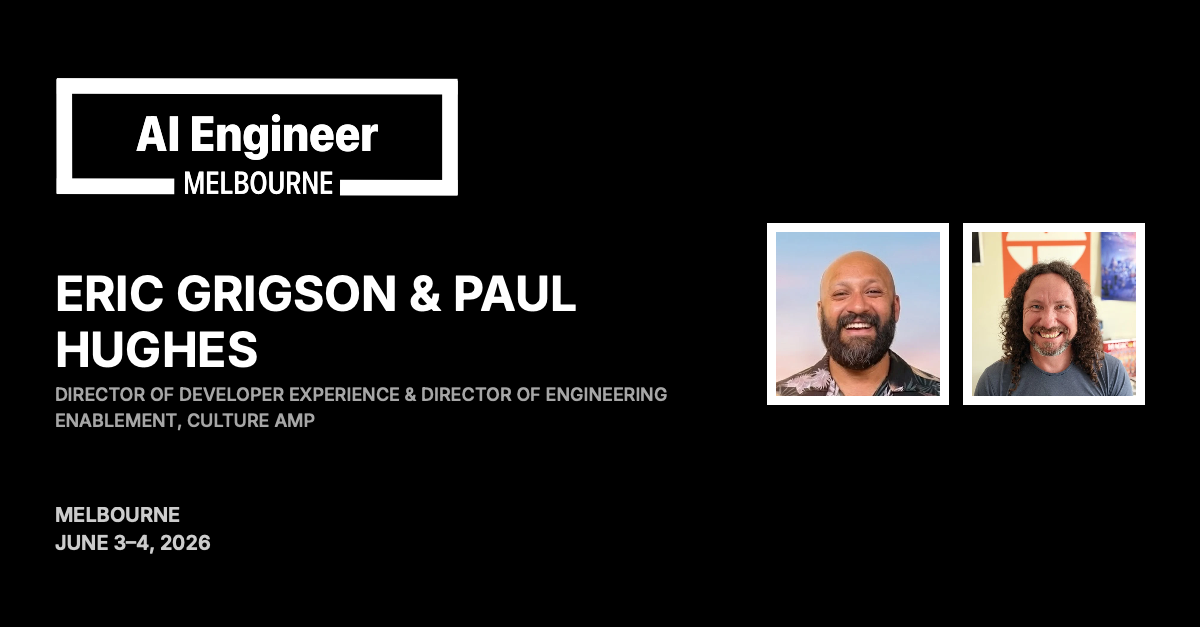
What We Learned Taking a Culture-First Approach to AI Adoption at Scale
When a new technology arrives at an engineering organization, the typical response is predictable: roll out the tool, measure adoption, monitor code output. But what if the real story isn't about the tool at all — it's about how people actually work?
Culture Amp faced this decision when deciding how to introduce AI coding tools to its 200-person engineering organization. The company is built on the thesis that culture drives outcomes, so they approached AI adoption the same way: people first, tools second.
The difference this made turned out to be measurable. Instead of a top-down mandate, Culture Amp ran a careful, data-driven rollout across 88 engineers, tracking not just adoption metrics but the deeper signals that matter to engineering organizations. They monitored DORA metrics (deployment frequency, lead time, change failure rate, mean time to recovery), watched how PR sizes shifted, tracked merge frequency, and measured MTTR — the moment-to-moment reality of what happens when AI tools enter an engineering workflow.
What emerged was surprisingly nuanced. AI coding tools don't uniformly speed up engineering. They change how engineers work, and that change looks different depending on the context, the engineer, and the team. Some engineers became dramatically more productive; others found the tool interrupted their flow. Some teams used it as a leverage point for working on harder problems; others used it to handle more volume. The culture mattered as much as the capability.
This matters now because organizations are at an inflection point with AI tooling. The early adopters who moved fast without thinking about culture are running into friction: attrition of experienced engineers who feel displaced, teams where some people use the tools and others don't (creating coherence problems), organizations where AI adoption looks good on dashboards but feels hollow on the ground.
Culture Amp's approach suggests an alternative: design the adoption experience, not just the rollout. Involve engineers in the decision. Help teams figure out their best use cases rather than imposing a standard one. Measure what actually matters — not just code written, but team health, problem-solving capacity, and whether engineers feel more agency or less.
The data also hints at something deeper. When engineers get to choose how and when to use AI tools, they tend to use them for what matters: the mechanical parts of the job, the boilerplate, the patterns they've solved a hundred times. They keep the interesting problems for themselves. That's not laziness; that's good judgment. A culture-first approach respects that judgment.
For teams considering AI adoption — or already partway through it — the lesson is clear: the tool is the easy part. The hard, valuable, and often overlooked work is creating the conditions where engineers can choose how to work and feel ownership of that choice. That's where the real outcomes live.
Eric Grigson and Paul Hughes bring this perspective to AI Engineer Melbourne 2026 on June 3-4, sharing what Culture Amp learned about culture-first AI adoption and what the 88 engineers actually showed.
Great reading, every weekend.
We round up the best writing about the web and send it your way each Friday.