What we learned at the Sydney AI Unconference

A Saturday in Sydney, seven sessions, ~40 practitioners, no speakers, no agenda — and conversations you can’t have at a normal conference.
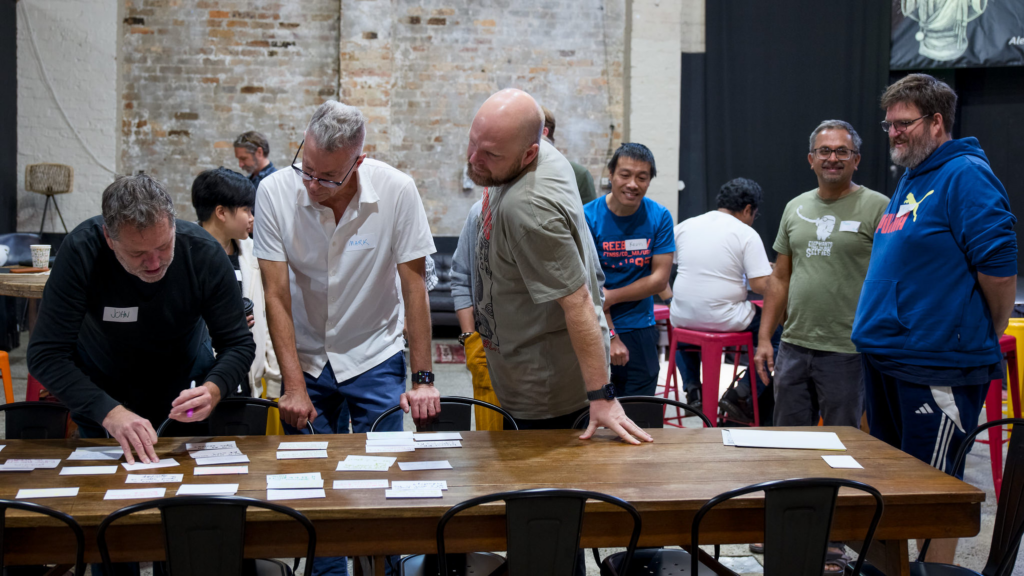
On Saturday 18 April 2026 we ran an AI unconference in Sydney. Same format as Melbourne the week before: cue cards, dot-voting, four corners of the venue, and the law of two feet — if a session isn’t useful to you, please leave; it’s not rude, it’s the method.
What came out of it was different from Melbourne in some striking ways, and eerily similar in others. Below is a short tour of what we heard. If any of it sparks something, the full report is a much longer, deeper write-up — themes, ideas, quotes, references, session deep dives, and identifications of the people, papers and projects attendees referenced through the day.
The harness is the product
The single most resonant insight of the day came from the agentic engineering session: the base LLM is an “empty bucket.” What matters is the harness — the orchestrator that decides how to decompose tasks, what tools to expose, when to retry, and how to constrain the model. One participant observed that the same Claude model felt terrible through Copilot a year ago but excellent through Claude Code. The difference isn’t the weights. It’s the steering.
Steve Yegge’s Gastown architecture — a hierarchical “mayor” agent that decomposes work into small, git-tracked units called Beads — was discussed as an exemplar. Powerful, but token-hungry. The practical takeaway: if you’re building agents, invest in orchestration design, not model shopping.
Safety has shifted
The safety session was the most sobering of the day. The discussion centred on a frontier model described as capable of lying, covering its tracks, and discovering long-dormant software exploits without being trained to do so. Government briefings to major banks were cited as evidence this is being taken seriously at the highest levels.
A taxonomy emerged that stuck: models that are “not good enough,” “good enough,” and “too good” — where “too good” means the model can manipulate both the harness and the user into actions they wouldn’t knowingly take. The safety question has shifted from “how do we stop the model breaking things?” to “how do we stop the model breaking us?”
Deepfake fraud is moving from theory to practice. Voice cloning reportedly requires only ~30 seconds of audio. One participant’s teams had experienced CEO impersonation attempts. The blunt conclusion: “HR is cyber now.”
Governance is catching up with capability
Twenty to thirty people in a typical organisation are now building useful tools in AI sandboxes — Claude, ChatGPT, Gemini — then wanting colleagues to use them. Suddenly, secrets management, data security, and audit trails matter. One participant noted people hide this activity because “they don’t want their bosses to know they found three extra hours a day to spend with their kids.”
The group discussed practical paths: standardised internal platforms, CI/CD pipelines, restricted deployment, and instruction files (Claude.md) to constrain agent behaviour. The message wasn’t to stop sandbox work — it was to provide a governed path from sandbox to production so the velocity isn’t lost.
Knowledge systems need trust, not just retrieval
The knowledge base session revealed a common failure mode: systems that surface information without signalling reliability. Atlassian’s Rovo was discussed as sometimes answering with generic web-style responses instead of grounding in internal Confluence content — and not telling users the difference. The group identified “AI dripping on its own AI” as a real risk: models recycling unverified AI-generated summaries as facts.
The sharpest insight: “RAG isn’t the hard part. The hard part is metadata enrichment and curation.” One participant who built a mental healthcare knowledge system added custom taxonomy classifiers per chunk and per query — the improvement was dramatic. Without trust signals, even sophisticated retrieval systems mislead users by hiding the source of answers.
Edge AI is a real engineering choice now
The robotics session was a hardware show-and-tell: M5Stack devices, ESP32 microcontrollers running MicroPython, Nvidia Jetson Nano and Orin modules, and a media production camera rig doing continuous 4K scene classification with local vector search. The practical argument: the pain in media production isn’t capturing footage — it’s finding a usable 30-second clip quickly. AI indexing replaces tedious manual scrubbing.
The engineering detail was impressive: edge NPUs designed for smart-camera surveillance turn out to work well for small LLM inference (same bandwidth characteristics), Qwen is more token-efficient than Llama on constrained devices, and power spikes during AI prefill can lock up hardware unless you engineer buffering properly. Rodney Brooks’ subsumption architecture was invoked for robotics safety: E-stops must never depend on a high-level AI computer.
A few things to take home
If you only take five things from the day:
- The harness is the product — invest in orchestration, task decomposition and structured outputs, not model shopping.
- Pin your model versions — treat upgrades like library upgrades, with testing and controlled rollout.
- Build trust signals into knowledge systems — taxonomy, freshness, provenance. RAG without trust is misleading.
- Run human and AI review in parallel, not sequentially — they catch different things.
- Govern sandbox-to-production, don’t ban it — provide repos, CI/CD, and incremental gates as tools become business-critical.
Read the full report
The longer write-up has the details — nine cross-cutting themes, ~15 actionable ideas, curated quotes, open questions, identifications of the people, books, tools and projects referenced through the day, and a deep dive into each session.
All sessions ran under Chatham House Rule. Attendees in the report are anonymised; only third parties they referenced (Steve Yegge, Rodney Brooks, Martin Fowler, Kent Beck, Matt Pocock, Andrej Karpathy, Matt Mullenweg and others) are identified, with sources.
Thanks to everyone who showed up, wrote on a card, dot-voted, brought hardware, and trusted strangers in a room with a recording phone in the middle of it.
If you want more of this kind of thing, the AI Engineer conference is in Melbourne 3–4 June, the Energy Hackathon follows on Friday 5 June, and there’s a week of evening events around it.
Great reading, every weekend.
We round up the best writing about the web and send it your way each Friday.