What Killed My Chat-as-a-Service? — Shubh Chatterjee at AI Engineer Melbourne 2026

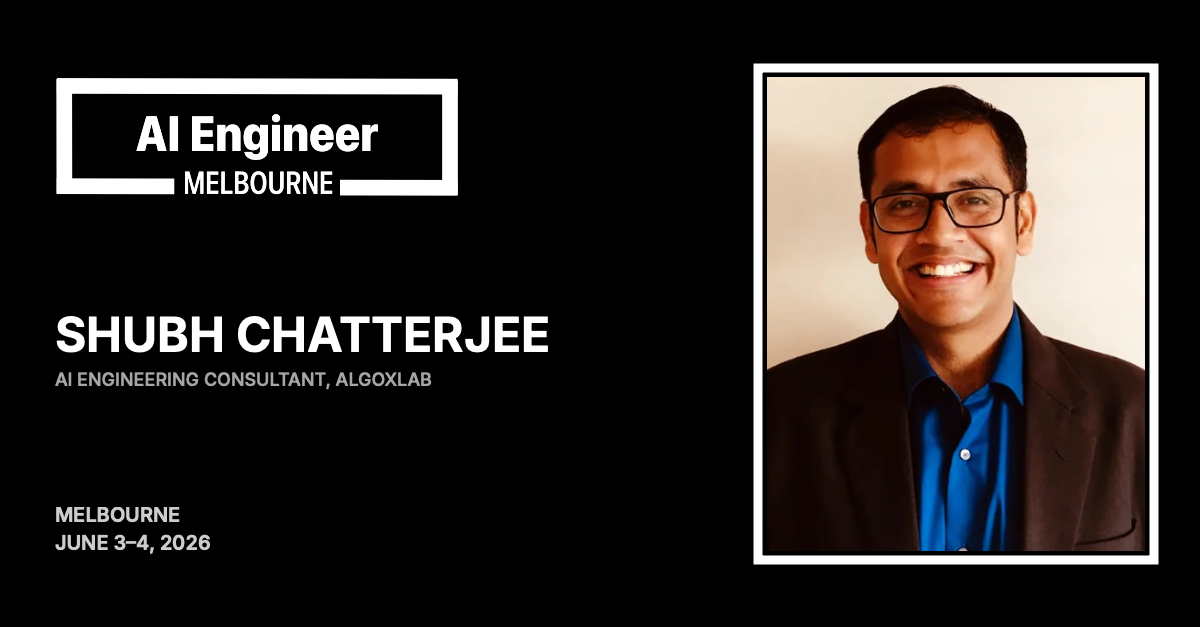
What Killed My Chat-as-a-Service? The Economics of AI Product Death
A promising AI product launches to excitement and early adoption. The demo is impressive. Users sign up. Press coverage arrives. And then, quietly, the product fails—not due to technical limitations or bad marketing, but from economics that were never addressed in the initial business model. This is not a story unique to one failed startup; it's becoming a pattern in AI products, and understanding why reveals something important about sustainable AI engineering.
The chatbot seemed like an obvious business opportunity. The technology works. Users would clearly benefit from a conversational interface to some domain-specific problem. The company built a solid product, deployed it, and watched early-stage metrics that looked promising. But those initial metrics were misleading because they measured the wrong things.
The core problem was inference cost. Each conversation involved multiple LLM API calls. Each user interaction meant token processing. As usage grew, the cost per user per month climbed steadily. The unit economics never worked—not at any scale. Pricing the product to cover infrastructure costs meant customers wouldn't pay. Absorbing the costs meant burning through funding. There was no viable path between these two realities.
But cost alone doesn't kill products; plenty of companies operate at a loss for years while building user bases. The deeper problem was user retention. The early adopters were excited about the technology itself. They tried the product because it was novel, and they were willing to tolerate limitations in exchange for the experience of talking to an AI. But as novelty wore off, retention plummeted. Users who initially engaged daily dwindled to monthly visitors. The product wasn't solving a problem that justified the persistent habit formation required for a viable business.
This gap—between the excitement surrounding AI demonstrations and the reality of sustained user value—is the actual killer. The team had confused technical capability with product-market fit. An LLM could generate good responses. But generating good responses wasn't the same as solving a problem users cared about enough to return repeatedly. The demo worked in a controlled environment where the use case was hand-selected. Real usage patterns were messier, requirements less clear, and value proposition less obvious.
Many AI product teams are facing versions of this dynamic right now. The excitement around large language models and generative AI has created a bubble of uninspected assumptions: that natural interfaces are inherently valuable, that being "powered by AI" is a sufficient differentiator, that impressive demos translate to defensible products. These assumptions matter because they drive investment and engineering effort toward products that look good in presentations but don't sustain engagement in practice.
The engineering implications are worth examining. A technically sophisticated AI product that no one uses regularly is a failure regardless of its engineering elegance. This means that AI product development can't be purely a technical problem—it requires clear-eyed product thinking from the beginning. What problem does this solve that justifies repeated use? What would users rather do instead? How much would they pay? These aren't questions you answer after launching; they should shape what you build.
The data also matters differently than teams often assume. Early-stage retention metrics and engagement patterns are more predictive of long-term viability than initial signup curves. If your AI product can't maintain week-two retention above certain thresholds, or if usage drops dramatically after the novelty wears off, those are architectural red flags not surface-level UX problems.
The most mature AI product teams now treat sustainability economics as a first-class design constraint, not an afterthought. Cost per interaction, cost to serve your most engaged users, the actual willingness to pay at scale—these become design requirements that shape what features you build and how you architect your system. The engineering challenge is no longer just "can we build an AI system that works" but "can we build an AI system that works profitably for users who will actually use it repeatedly."
Shubh Chatterjee explores these hard lessons from failed AI products at AI Engineer Melbourne 2026, June 3-4 in Melbourne, Australia.
Great reading, every weekend.
We round up the best writing about the web and send it your way each Friday.