Beyond Forgetful Bots: Architectural Patterns for Persistent, Proactive Claw-Style AI Agents — Navan Tirupathi at AI Engineer Melbourne 2026

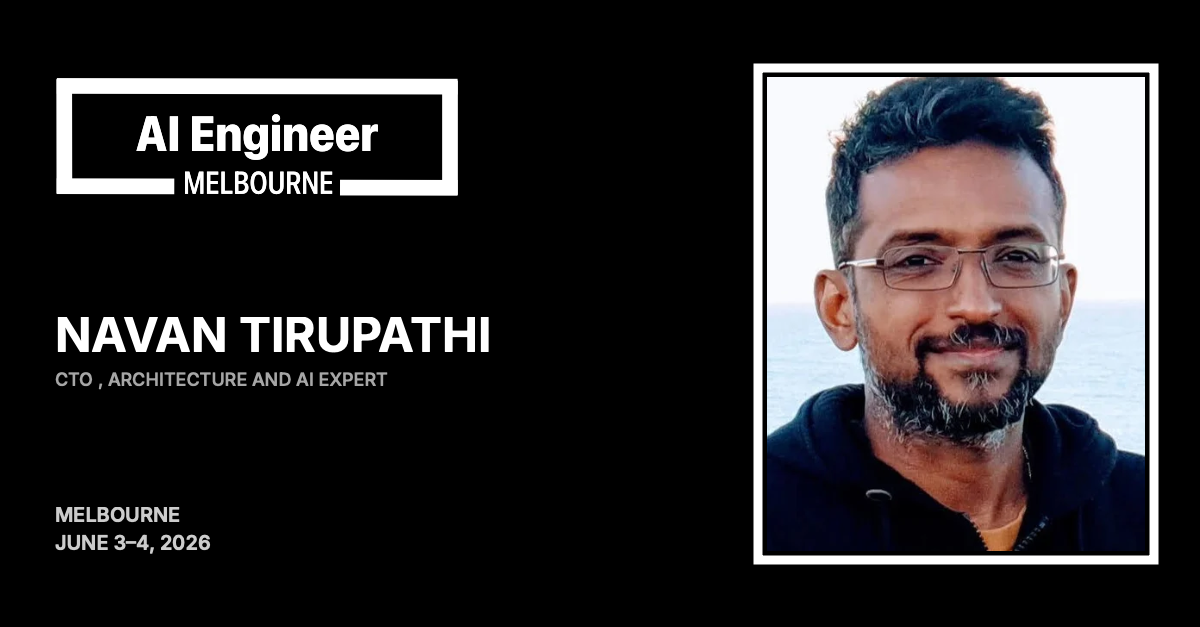
Beyond Forgetful Bots: Architectural Patterns for Persistent, Proactive AI Agents
Most AI agents in production are fundamentally stateless and reactive. They receive a request, process it, generate a response, and forget everything about the interaction. This architectural simplicity makes them easy to deploy and scale, but it also means they can never develop genuine understanding of context, history, or user intent across conversations. They're like amnesiacs solving problems repeatedly with no memory of previous solutions.
The gap between this reactive model and how humans actually work is significant. A person accumulates context over months and years. They remember that you prefer verbose explanations or quick summaries. They know your constraints, priorities, and previous decisions. They can anticipate needs and proactively suggest actions. An AI agent that rebuilds its context from scratch for every interaction is fundamentally limited in ways that go beyond capability—it's limited in architecture.
Building persistent agents requires rethinking several foundational assumptions about how AI systems work. First, where does state live? In a stateless system, all information must be provided in each request. But if an agent maintains persistent state—memory of interactions, understanding of priorities, history of decisions—that state must be stored, retrieved, and integrated into each new interaction. This is straightforward architecturally but creates new challenges around storage, consistency, and managing context windows.
The second question is about proactivity. A reactive agent waits to be asked. A proactive agent identifies opportunities and takes action without explicit requests. This seems like a relatively small difference, but it requires fundamentally different permission models and architectural controls. You're no longer just processing user input; you're generating autonomous actions. The system needs frameworks for deciding when to act, what actions are safe, and how to handle failures when autonomous actions go wrong.
Consider a practical example: an agent helping manage a project. In the reactive model, every time you ask the agent about project status, it queries all the data fresh. In a persistent model, the agent maintains understanding of the project—key deadlines, critical dependencies, who's responsible for what. It notices when something changes unexpectedly and flags it proactively. It anticipates upcoming conflicts based on the schedule and historical patterns. It suggests optimizations without being asked.
Implementing this requires addressing several architectural challenges. Context management becomes critical. You can't fit the entire project history into the model's context window, so you need intelligent summarization—extracting the information that's most relevant to the current situation while discarding noise. This is hard. It's the difference between perfect recall (everything is context) and useful understanding (only relevant patterns are available).
Persistence also introduces consistency problems. If the agent has stale cached understanding of project state, and something changes externally, when does it refresh? How does it detect that its understanding is outdated? In reactive systems, this doesn't matter—each request triggers fresh data. In persistent systems, staleness is always a risk.
There's also the responsibility question. An agent that takes proactive actions is responsible for those actions in a different way than a reactive agent. If a proactive agent decides to escalate a risk, or propose a major change, or alert someone about a problem, those decisions have consequences. The architectural patterns need to include guardrails, explainability, and auditability that match the level of autonomy.
Some of the most advanced persistent agent architectures are beginning to emerge. They maintain continuously updated models of state (what's true about the current situation). They have learning loops where past decisions get evaluated and incorporated into future choices. They develop preferences that persist across interactions. They're designed around multi-turn conversations that build understanding over time rather than starting from zero each interaction.
These systems are harder to build than stateless agents. Testing is more complex because behavior depends on history. Debugging is harder because problems can emerge from accumulated state interactions. Scaling requires infrastructure for state management and retrieval. But the value is correspondingly higher. An agent that actually learns from interactions, remembers decisions, and anticipates needs is qualitatively different from one that approaches every conversation as a fresh start.
The architectural shift also changes how you evaluate agents. You can't just benchmark them on individual tasks—you need to understand their behavior over extended interactions. How do they handle changing context? How do they learn from mistakes? How do they build and maintain accurate models of the world they operate in? These are harder to measure than task accuracy, but they're more important for sustained productivity.
Organizations beginning to adopt persistent, proactive agents are discovering that the architectural patterns matter more than model selection. A smaller model with good state management and clear action guardrails outperforms a larger, more capable model that's bolted onto a reactive architecture. The interface between the agent and the systems it works with also matters more—how naturally can the agent learn about changes, propose actions, and understand constraints.
Navan Tirupathi explores these architectural patterns, including practical approaches to state management, proactive decision-making, and building agents that genuinely improve through interaction at AI Engineer Melbourne 2026, June 3-4 in Melbourne, Australia.
Great reading, every weekend.
We round up the best writing about the web and send it your way each Friday.