A Lot Going On Right Now–Your weekend reading from Web Directions

I am a pretty early riser. Something that happens to many parents, and even though my youngest is now well into high school, the early rising instincts have never gone away.
My friend Mark Pesce is an even earlier riser. Most mornings, well before six, I’ll look at my messages to find a thing or two at least that Mark has spotted early, something that happened overnight.
This morning, there were eleven messages. News of multiple new models and products from frontier AI companies. And there was more — not all of which I’ve caught up with yet (in my defence, it is 6:17 am).
Lenin, the central figure of the Russian Revolution over a century ago — an event that reshaped the entire 20th century — is famous for the aphorism: “There are decades in which nothing happens, and weeks in which decades happen.”
It’s a quote I took to using back in 2023. Less than three years ago, but in some ways seemingly so much longer. It felt then like the pace of change had accelerated, that the work we needed to do as technologists to stay current had increased dramatically.
I smile at the naivety of thinking that, in comparison with today.
In the last few weeks, I have had two genuine jaw-drop moments. I’ve perhaps had three in my entire career.
I’ve been working as a software engineer with these models from OpenAI, Google, and Anthropic for three or more years now. Seen them incrementally improve. But something happened, I think, with the release of Opus 4.5 in Claude Code that was materially different from what we’d seen before. This was an entity that could take initiative, could genuinely reason, could discover solutions to difficult problems autonomously.
Less than two weeks ago, I installed OpenClaw (the bot formerly known as Clawdbot). For reasons I find it impossible to put properly into words, something is different about the experience of working with it. I’ve seen scepticism about it from many online, but I’ve also seen others, when they get it working, have a similar moment to mine. It is very hard to put into words. The way I have been expressing it over the last week or two is this: if we had taken these technologies — OpenClaw, Claude Code as it stands now — and I’m sure this equally applies to other systems, these are just what I’m working with at the moment — if we’d taken them back to the end of 2022, let alone a decade before that, and given them to anyone in the world, I think almost no one would have disagreed with the characterisation of them as being intelligent.
You can say they’re “just predicting the next token” or that they’re stochastic parrots all you like. Strictly speaking. that may very well be true. But there are emergent phenomena about them that are materially different to that.
Indeed, just this week, the venerable science publication Nature published a piece by professors in computer science and philosophy arguing that the technologies we have now are not simply intelligent but AGI.
In the last few weeks, we’ve seen the release and multiple name changes of the most-starred GitHub repository of all time (OpenClaw). It is almost entirely developed using large language models.
Then just overnight, we saw two incremental but significant model improvements — GPT-5.3 Codex from OpenAI and Claude Opus 4.6 from Anthropic.
And to somehow capture how much all of this is now part of the zeitgeist: last night, as I waited for my daughter to finish her soccer training, a group of men in their thirties and forties waiting to go on for their game were talking about AI. Not in some naive, hand-wavy way — they were talking about it in quite technical terms.
Over the last day or so, major financial markets have become very concerned about the impact these technologies may have on the entire software business. This was already well underway — in the last two years, Adobe, a company that has very much leaned into and championed AI technologies as part of their products, has fallen 50% in valuation — but investors now seem to have woken up to the broader implications. Around a trillion dollars yesterday was wiped off the value of a broad range of software and technology companies in financial markets.
It’s fair to say that I am often overwhelmed. But I’m also excited. For all the concerns there may be with these technologies — and I think at least a number of those are genuinely significant and need to be addressed — it is clear they are having a profound impact in a great many areas of industry and economy, while at the same time that impact is clearly overhyped in other areas of their application (Microsoft’s revelation that only around 15% of Office 365 users are paying co-pilot users is one indicator of that).
It’s like we’re speed-running the period between 1980 and 2000 or even 2010, when the rise of the personal computer and then the consumer internet had their transformative effect. We’re compressing those decades into a far shorter timeframe. Maybe not literally weeks, but perhaps not too far off.
Right now, I genuinely feel the landscape of computing for the next decade or more — perhaps half a century — is being reshaped. The foundations of those decades are being built.
I know people who, over the last year or so, within months, have gone from active scepticism about these technologies to being genuine world leaders in developing techniques that are widely used and adopted.
And I kind of know this feeling from the 1990s, with the emergence of the web. That took longer, but at times it had this kind of urgency.
Time and again you might have felt — I certainly did, I remember this clearly — “Well, this is over. This product has arrived. This technology has arrived. This technique has arrived. We’re there now. All that’s left to do is fill in the details.” But that’s not how it works.
Decades later, new platforms like iOS, and still today and whole new swathes of web technologies continue to emerge.
Perhaps, like me, you feel overwhelmed and wonder what’s to be done. I think real understanding and expertise comes through just working with these technologies. It’s still all so poorly understood, whether by researchers at frontier labs or by anyone simply trying to work out how best to apply them.
I think it’s a time for curiosity and exploration. If anyone wanted advice as to what to do right now to keep up, I’d say carve out time where you can for that — in really practical terms, work with these technologies alongside what you already do. All the time. Learn how they can help you do what you do, and in that way develop intuitions about how they work, how they — dare I say it — think.
As Hamish Songsmith put it just this week:
A growing chasm separates those building around AI from those still debating it — and it has nothing to do with model size or vendor choice.
On one side: people who aren’t fixated on measuring or justifying it first. They have experimented enough and understand that, applied well, AI generally means more productivity. They’re already building tools like Ralph loops, OpenClaw, and AI factories such as GSD and Gas Town.
If those names sound like “random internet projects,” that’s exactly the problem: capability is moving outside your organisation faster than you recognise.
A couple of years back, at the height of the Taylor Swift Eras Tour mania, my daughters got me an “A Lot Going On Right Now” t-shirt, which Swift had made famous by wearing during the tour. It’s in my drawer, but I probably should be wearing it every single day.
Enough from me, here’s some things I found this week that I think you might find valuable.
Elsewhere this week
AI & Intelligence
Does AI Already Have Human-Level Intelligence? The Evidence Is Clear

In 1950, in a paper entitled ‘Computing Machinery and Intelligence’, Alan Turing proposed his ‘imitation game’. Now known as the Turing test, it addressed a question that seemed purely hypothetical: could machines display the kind of flexible, general cognitive competence that is characteristic of human thought, such that they could pass themselves off as humans to unaware humans?
Three-quarters of a century later, the answer looks like ‘yes’. In March 2025, the large language model (LLM) GPT-4.5, developed by OpenAI in San Francisco, California, was judged by humans in a Turing test to be human 73% of the time — more often than actual humans were. Moreover, readers even preferred literary texts generated by LLMs over those written by human experts.
Source: Does AI Already Have Human-Level Intelligence? The Evidence Is Clear — Nature
I’ve been working extensively with most of the major models—from Google, OpenAI, Anthropic, and others—for several years now. I’ve got a great deal of value from them in all kinds of ways. But until December last year, I would have characterised these as often valuable, sometimes problematic, power tools. With the release of the most recent models from OpenAI, Google, and Anthropic, and new harnesses like Anti-Gravity, Co-Work, and now Codex from OpenAI, I wouldn’t characterise them as power tools anymore. I’ve been doing technology stuff for the vast majority of my life—well over 40 years. In all that time, I’ve had perhaps three truly jaw-drop moments when I saw something that pointed in a completely new direction.
Two of them have happened in the last four to six weeks. Working with Claude Code and Co-Work, we now have systems that are autonomous, that take responsibility, that interact the way intelligent, educated, capable humans would. And in the last two weeks or so, Claude Clawdbot has brought something different: an immediacy, an always-on quality. I’m not fooled into thinking it’s a person.
But if you took one of these systems back to November 2022, when ChatGPT first became widely available, I’d argue that everyone you showed it to—including researchers in the field, people who’d been working on machine learning and AI for years or decades—would have said this is intelligent. I’m not sure the conversation about whether it is intelligent even matters that much, except perhaps as a relatively abstract philosophical one. But I think it’s quite extraordinary that Nature—one of the longest-running and highest-profile science publications, with a history going back over 150 years—is essentially saying that this contemporary set of technologies has human-level intelligence.
AI Open Models Have Benefits. So Why Aren’t They More Widely Used?
A new paper co-authored by Frank Nagle, a research scientist at the MIT Initiative on the Digital Economy, found that users largely opt for closed, proprietary AI inference models, namely those from OpenAI, Anthropic, and Google. Those models account for nearly 80% of all AI tokens that are processed on OpenRouter, the leading AI inference platform. In comparison, less-expensive open models from the likes of Meta, DeepSeek, and Mistral account for only 20% of AI tokens processed. (A token is a unit of input or output to an AI model, roughly equivalent to one word in a prompt to an AI chatbot.)
Open models achieve about 90% of the performance of closed models when they are released, but they can quickly close that gap — and the price of running inference is 87% less on open models. Nagle and co-author Daniel Yue at the Georgia Institute of Technology found that optimal reallocation of demand from closed to open models could cut average overall spending by more than 70%, saving the global AI economy about $25 billion annually.
Source: AI Open Models Have Benefits. So Why Aren’t They More Widely Used? — MIT Sloan
I’ll admit to being guilty here too. I use multiple closed models extensively, but very little by way of open ones. It’s not a particularly thought-through choice—it’s what I’ve gotten used to in terms of API setups, workflows, and muscle memory. There are no network effects here, but those big, closed, expensive models keep getting the mindshare and user share.
There’s a sense that in particular the Chinese frontier labs—who often produce open models—are more than nipping at the heels of the American frontier lab companies. So perhaps this is something we’ll see change over the coming months.
AI & Software Engineering
The Growing Chasm: AI Adoption in Large Organisations

A growing chasm separates those building around AI from those still debating it—and it has nothing to do with model size or vendor choice.
On one side: people who aren’t fixated on measuring or justifying it first. They have experimented enough and understand that, applied well, AI generally means more productivity. They’re already building tools like Ralph loops, OpenClaw, and AI factories such as GSD and Gas Town.
If those names sound like “random internet projects,” that’s exactly the problem: capability is moving outside your organisation faster than you recognise.
Source: Hamish Songsmith — Blog & Links
The transformation of software engineering—and more—has kind of already happened. Like the future, it’s not evenly distributed, but it has arrived. What it actually looks like in months and years to come, no one knows. All we can do is experiment and explore. The waterfall methodology held sway for the first half of my software engineering and technology career. Agile has held sway for the second half. These things weren’t brought into being with a click of the fingers. They emerged from lessons software engineers were learning.
The mistakes they were making. The errors they saw—human and structural. And over time, a set of practices, a set of patterns, and built on top of them, tools and even programming languages, emerged over years and decades. Just as Agile eclipsed Waterfall, a new set of practices will eclipse Agile. It’s happening already, driven by a profound change in what computation is—one that has happened more quickly than we’ve ever seen before. You have the opportunity to be part of that conversation, to help shape what happens next. But that window of opportunity is closing.
Hierarchical Memory Management in Agent Harnesses
AI coding agent LLMs software engineering
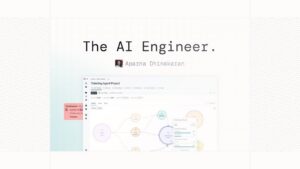
We’ve seen incredible momentum toward files as the memory layer for agents, and this has accelerated significantly over the last year. But why use the file system, and why use Unix commands? What are the advantages these tools provide over alternatives like semantic search, databases, and simply very long context windows?
What a file system provides for an agent, along with tools to search and access it, is the ability to make a fixed context feel effectively infinite in size.
Bash commands are powerful for agents because they provide composable tools that can be piped together to accomplish surprisingly complex tasks. They also remove the need for tool definition JSON, since bash commands are already known to the LLM.
Source: Hierarchical Memory Management in Agent Harnesses — Aparna Dhinakaran, LinkedIn
It’s fascinating that a well over 50-year-old operating system—and approach to operating systems—that is Unix seems to empower agents to work autonomously. Here, Aparna Dhinakaran looks at why Unix commands and the Unix approach of small pieces loosely coupled, piping from one function to the next, is so effective.
AI & Business Economics
The Coherence Premium

In 1937, the British economist Ronald Coase asked a question that seems almost embarrassingly simple: why do firms exist at all? If markets are so efficient at allocating resources, why don’t we just have billions of individuals contracting with each other for every task? Why do we need these hulking organizational structures called companies?
His answer, which eventually won him a Nobel Prize, was transaction costs. It’s expensive to negotiate contracts and coordinate with strangers, to monitor performance and enforce agreements. Firms exist because sometimes it’s cheaper to bring activities inside an organization than to contract for them on the open market. The boundary of the firm, Coase argued, sits wherever the cost of internal coordination equals the cost of external transaction.
We’re in a Coasean inversion. The economics that made large firms necessary are reversing. But most people are looking at this transformation through the wrong lens. They see AI as a productivity tool, a way to do more faster. They measure success in hours saved or output multiplied, and this misses the point entirely.
Source: The Coherence Premium — Joan Westenberg
I’ve been thinking a lot about exactly this, without putting it in nearly as good a framing as Joan does here. Computing since 1980 has largely done one of two things: it’s made large existing enterprises and organisations more productive, and more recently it’s opened up new kinds of consumer products like social networks and streaming.
What Joan argues here—and what I’ve been thinking quite a bit about—is what happens to large organisations when, in order to take advantage of the promise of AI, they need to transform their own structure. Large organisations treat change as a virus; they have antibodies against it. So when we see these studies from the likes of MIT about how some huge percentage of all AI projects have no ROI, perhaps that’s right. But it’s telling us something about the capability of large organisations to benefit from adopting AI.
AI & Product Design
How Product Discovery Changes with AI
AI product design product discovery
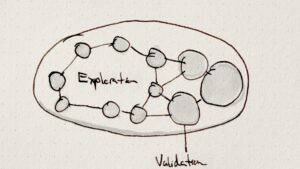
In Jenny Wen’s talk at Hatch Conference in 2025, “Don’t Trust the Process,” she raises an important point: the processes we’ve established are rapidly becoming lagging indicators. Process is important, but it should work for you, not the other way around.
People worshipped the process artifacts, not the final result. We’re in a moment where the moment you document a process, it becomes irrelevant. I don’t believe it’ll be like this forever, but until software is completely rewritten with AI as a core capability, it’s going to be like this for a while.
So, where does Product Discovery change? Let’s revisit those four risks.
Source: How Product Discovery Changes with AI — David Hoang, Proof of Concept
Last week, we referenced Jenny Wen’s talk at Hatch Conference where she revisited the product design process that has been widely adopted over the last decade or so. She asked the question: does this still make as much sense in an age of AI? The answer, for the most part, is probably not. It’s something we’re seeing elsewhere, particularly with software engineering, where that long-term software development life cycle we’ve evolved over the last 15 or 20 years perhaps doesn’t make as much sense in a world of Ralph loops and Gas Towns and, of course, other approaches to LLM-based software development. Here, David Hoang asks a similar question about product discovery.
We had a talk at our recent Next conference—the video will be available soon—which also considers this particular issue. In short, we’ve developed processes and approaches that made sense in terms of the scale and capability of humans and human teams across design, product, and engineering. Now that AI large language models are a part—indeed, often a significant part—of our process, those approaches may not make as much sense. I don’t think folks like David or Jenny have so much as answers right now, but rather are thinking about existing processes and the sorts of things that might change. Whatever your field, I think it’s well worth considering these challenges, which also represent opportunities.
CSS & Frontend Development
Is Learning CSS a Waste of Time in 2026?

With modern frameworks, component libraries, and utility-first CSS, it’s a fair question.
Most frontend developers today rarely write “real” CSS. Layouts come prebuilt. Responsiveness is handled for us. Accessibility is supposed to be baked in. If something needs styling, we tweak a variable, add a utility class, or override a component token.
Source: Is Learning CSS a Waste of Time in 2026? — DEV Community
I’m going to take a stab at this question, and I think my answer is completely the opposite. I’ll state my biases upfront: I think CSS is a profoundly important language that many, many software engineers have spent the better part of at least 15 years trying to abstract away the nuances and complexities of. The argument in a nutshell is that developers use Tailwind and CSS-in-JS of various flavours and never need to actually write CSS, so they never really need to understand it. I’ve argued—and I increasingly believe—that the tower of abstractions we’ve built to hide the underlying capabilities and complexities of the web platform in CSS, in the DOM, in JavaScript, in HTML, in ARIA, that tower is no longer relevant. LLMs understand the DOM. They understand JavaScript. They understand CSS incredibly well. These are really incredibly well-documented technologies.
There are huge codebases out there. It astounds me that anyone would think it made any sense to get LLMs to generate anything of a higher-level abstraction than the underlying platform capabilities, because those abstractions are written for humans, not for LLMs. They get in the way; they come at a really high cost. We made the trade-off to get better developer experience at the cost of—in particular—performance, complex build tools, and on and on. So, that means you should all learn CSS, right? Well, yes and no. I think, increasingly, what good software engineers will do is understand the capabilities of the technology. They won’t have a hammer and use it incredibly effectively every time they have a problem. They won’t use Flexbox all the time or whatever tool they particularly want to use. Instead, they will know the subtleties, complexities, and capabilities of their platform, their toolset, or their language, so they can guide code generation tools to use the right tool at the right time.
They will know when Flexbox or Grid or absolute positioning or whatever it is, is the right layout choice. So forget everything above the layer of the core technology.
You won’t be writing “real” CSS—your large language model will be writing that—but it shouldn’t be writing Tailwind. That’s a technology created to abstract away the complexities and, in many cases, the power of CSS on the web platform. It’s a uniquely bad decision when you’re working with code generation to choose a tool like that. What should you do as a developer? Learn the concepts. Have an encyclopaedic knowledge of the capabilities of the language and platform that you use. But you’re not going to be writing the code. You’re going to be guiding the tool that you use to write the code. And increasingly, you will use specification documents and plan documents to shape the scope of what the code generation tool will produce.
Great reading, every weekend.
We round up the best writing about the web and send it your way each Friday.