Craft in the Time of Agents — Annie Vella at AI Engineer Melbourne 2026

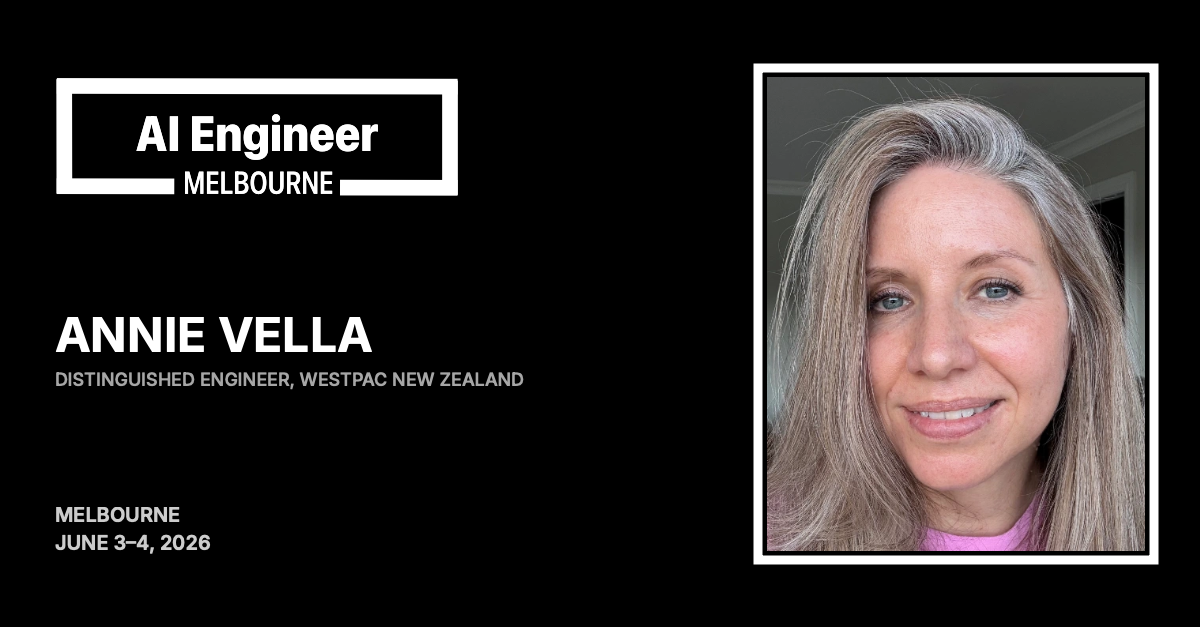
Craft in the Time of Agents
You're shipping more than ever. Features that would have taken your team weeks to build now take days. You're moving faster, scaling further, doing more with less. And by Wednesday you're exhausted.
This is the paradox of AI coding assistants that almost no one talks about. You feel more productive. The metrics say you're more productive. But the thing that used to sustain you—the craft of writing code, the problem-solving depth, the flow of fitting pieces together until they work—that's gone. What's replaced it feels less like engineering and more like supervisory work: directing AI output, evaluating what it generates, correcting its mistakes, coaxing it in the right direction.
You're getting more done while enjoying it less. And the uncomfortable question is: why does that matter if you're shipping faster?
Annie Vella has spent the last few years researching exactly this question. As Distinguished Engineer at Westpac New Zealand, she's spent two decades navigating startups, scale-ups, and large enterprises. But recently, she completed a Master's of Engineering exploring how professional software engineers actually experience AI coding assistants—not in theory, but in the lived reality of their working days.
What she found is nuanced and challenging. The transition to AI-assisted development doesn't hit everyone the same way. Some people thrive. Others feel unmoored. And the difference comes down to mindset more than circumstance.
Think about what's actually changed. When you write code from first principles, you're making choices about structure, trade-offs, and implementation details. Each choice teaches you something about the problem. You fail, you debug, you understand more deeply. That feedback loop—problem to solution to understanding—is where mastery develops. It's also what makes the work feel meaningful.
When an AI agent writes code and you evaluate it, the feedback loop changes. You're no longer learning through making mistakes; you're learning through spotting and correcting mistakes someone else made. It's different cognitively. It feels less like creation and more like curation. Less like craft and more like quality control.
And it's genuinely exhausting. You're making more decisions per hour because you're reviewing more code. You're switching contexts constantly: from evaluating one suggestion, to refining a prompt, to testing the result, back to refinement. Context switching is draining. And because AI code is often plausible but subtly wrong—it compiles, it runs, it produces output, but there's a logic error three commits in—the stakes of evaluation are high. You can't relax into the review. You have to think hard.
But here's where Vella's research gets interesting. Not everyone experiences this as negative. Some engineers thrive when freed from the grind of syntax and boilerplate. They lean into the direction and orchestration role. They enjoy the speed and the ability to explore more ideas. The craft they find is different—it's in problem specification, in understanding what matters, in making bigger architectural decisions faster.
The difference seems to correlate with where you are in your career and what you value. Someone early in their career might need the deep learning loop that comes with writing code from scratch. Rushing that foundation can leave you without the mental models that make you effective later. Someone mid-career might appreciate the shift to higher-level problem-solving. Someone senior might find the speed liberating—finally building the system they've been thinking about for years.
The uncomfortable truth is that AI coding assistants don't eliminate the trade-offs; they just shift them. You gain speed and breadth. You lose depth and the satisfaction of craft. Both matter. The question is whether you know what you're losing and whether the trade is worth it for you, personally.
There's also a systems-level question hiding here. If AI-assisted development works best for people who already know what they're doing—who can evaluate code quickly, who don't need the learning feedback loop—then it might actually increase inequality in engineering. Juniors might need human mentorship and deliberate practice more than ever, precisely because they're losing the learning-through-making path. Teams that can't afford to hire experienced engineers might struggle because their juniors aren't getting the developmental experience they need.
These are the conversations happening in the margins right now. Not in keynotes about productivity gains, but in one-on-one conversations between engineers who feel more capable and less fulfilled, who ship more and enjoy it less.
Annie Vella's research digs into these lived experiences. She's interviewed engineers across career stages, organisations, and contexts. She's seen the real patterns beneath the hype. And crucially, she's thinking about what this means for engineering as a profession—not just for individual productivity.
Her perspective at AI Engineer Melbourne 2026 (June 3–4) offers something rare: honest reflection on what we're gaining and losing as AI coding assistants reshape the work of software engineering. Not cheerleading, not doom-saying, but clarity about the real trade-offs and what different people need to thrive in this new landscape.
Great reading, every weekend.
We round up the best writing about the web and send it your way each Friday.