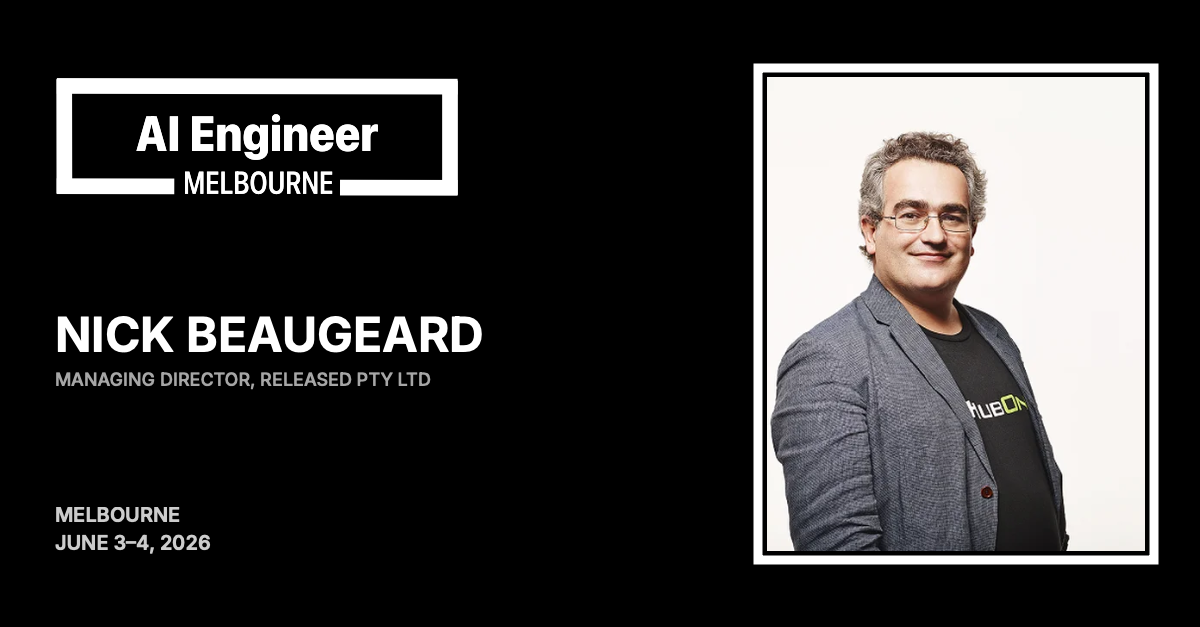
Spec driven AI development – A Real World Perspective — Nick Beaugeard at AI Engineer Melbourne 2026

Spec Driven AI Development: A Real World Perspective on Getting Reliable AI-Assisted Code
The difference between an AI system that generates useless code and one that reliably produces production-quality work often comes down to something surprisingly unglamorous: the specificity of the specification. When you give an AI agent a vague request—"build a user authentication system"—it will generate something that looks plausible but misses your actual requirements in subtle ways. When you give it a detailed specification—"implement user authentication with these specific password requirements, this specific token rotation schedule, error handling for these specific failure modes"—it reliably produces code you can ship.
This is not how the AI-generated-code narrative usually goes. The story we tell is about AI being so capable that it can infer your requirements from a sentence or two of description. The reality is that AI works best when given explicit specifications that eliminate ambiguity. This flips the traditional problem of AI development: instead of "how can we make AI smarter," the question becomes "how can we be clearer about what we actually want."
The shift from vague prompting to specification-driven development represents a maturing understanding of how to actually use AI for code generation. Early adopters threw prompts at AI systems and hoped for output they could use. More sophisticated teams realized that the effort needed to clarify requirements and write specifications often costs less than the effort to fix poorly understood AI output.
A good specification for AI development serves multiple purposes simultaneously. It documents what the code should do, which is useful for any future developer reading it. It constrains what the AI will generate, which dramatically improves the usability of the output. It becomes a test specification—once the code is generated, you can verify that it matches the specification. And perhaps most importantly, it forces the team to actually think through what they want before asking an AI to implement it.
Consider a practical example: building an API endpoint. A vague request might be "implement an endpoint that returns user data." A specification might describe: the exact URL path and HTTP method, the request parameter format and validation rules, the response schema including field names and types, the error conditions and their response formats, the authentication requirements, the rate limiting behavior, the logging that should occur. With this specification, an AI system can reliably generate correct code. Without it, the AI makes assumptions that diverge from what you actually need.
The specification approach also changes how teams think about the relationship between specification and implementation. In traditional development, specifications are often separated from code—they're maintenance burdens that drift from reality. In specification-driven AI development, the specification drives the code generation, which means there's inherent coupling between them. This can actually reduce technical debt because the specification is validated every time new code is generated.
There's also an economic dimension. Writing detailed specifications takes time. But in environments where AI is generating the code, that specification time directly translates to better code quality and fewer revisions. The cost of specification writing is recovered in the cost of code review and rework that doesn't happen because the code matches the spec more reliably.
Different teams are discovering that the level of specification detail that works varies by domain. Complex algorithmic logic might require extensive specification with examples and test cases. Straightforward CRUD operations might need less detail. Data transformation code might require detailed input/output specifications. The art is figuring out how much specification is necessary for the value of AI assistance to exceed the cost of writing the specification.
Some teams are also discovering that specification-driven AI development works better for certain architectural patterns. Microservices with clear interfaces and well-defined contracts are amenable to this approach. Monolithic systems with implicit dependencies are harder. The structure of your codebase influences how well specification-driven development works.
There's also a tool dimension. Specifications written in natural language are better than nothing, but specifications written in formats that tools can understand—structured schemas, executable tests, formal specifications—allow for much more reliable code generation. A specification that includes test cases, for example, gives the AI both the requirement and a way to verify it's meeting the requirement.
The maturity observation here is important: the teams getting the most value from AI development are usually the ones with the most disciplined approach to specifications. This might seem counterintuitive—shouldn't highly disciplined teams be suspicious of AI? The reality is that discipline in specification actually enables AI to work better. The same clarity that makes code maintainable and testable also makes AI-generated code reliable.
There's also learning value. As developers write specifications for AI to implement, they get better at understanding what their code should do. Vague requirements that seemed fine when a human would implement them become obviously incomplete when you're specifying what an AI should build. This discipline tends to improve code quality broadly, regardless of whether AI is involved.
The future of specification-driven development likely involves increasing tool support. Rather than writing specifications in prose, teams might work with specialized tools that help build specifications, validate them, and feed them to AI systems. The specification becomes less of a byproduct of requirements and more of a first-class artifact that drives both AI generation and human code review.
Nick Beaugeard shares real-world experiences implementing specification-driven development workflows, including lessons about specification depth, tool support, team discipline, and the actual ROI of the approach at AI Engineer Melbourne 2026, June 3-4 in Melbourne, Australia.
Great reading, every weekend.
We round up the best writing about the web and send it your way each Friday.