COBOL and AI: Building a Self-Serve Knowledge Layer for 2,000 Batch Jobs — Matthew Gillard at AI Engineer Melbourne 2026

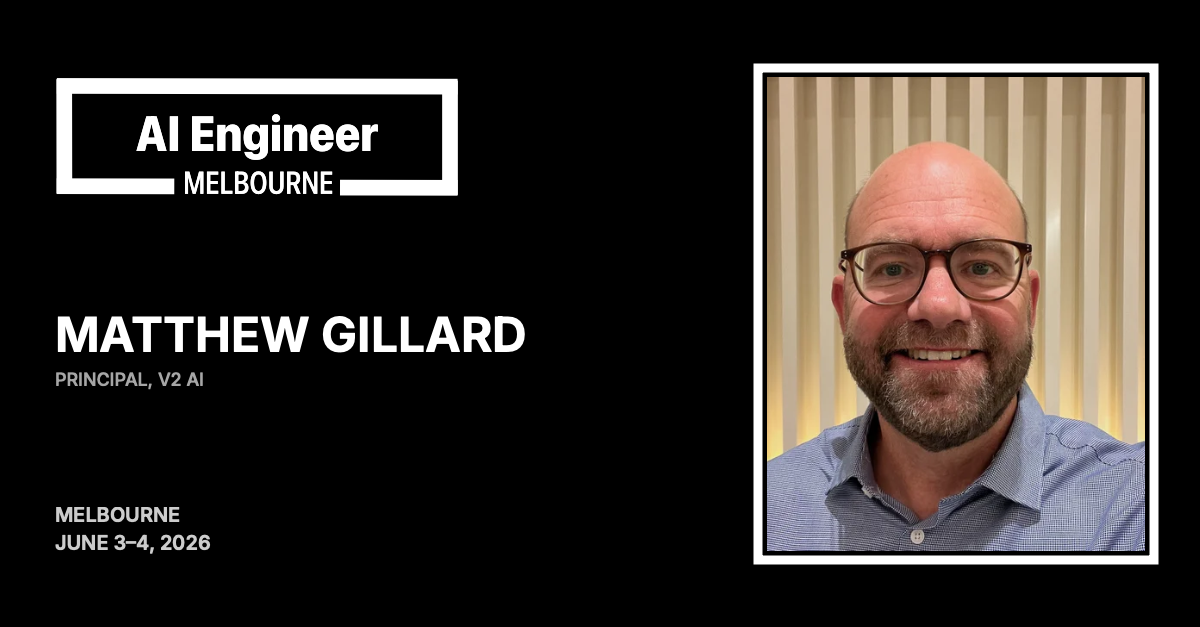
COBOL and AI: Building a Self-Serve Knowledge Layer for 2,000 Batch Jobs
The biggest obstacle to modernization isn't the technology. It's the knowledge locked inside legacy systems.
When you've got 2,000 COBOL batch jobs running your core operations, modernization planning hits a wall immediately. Someone needs to understand what each job does, what files it consumes, what it produces, which systems it connects to. That knowledge exists somewhere—embedded in decades of code, scattered across different teams, living in people's heads. Extracting it manually doesn't scale. Neither does guessing.
This is Matthew Gillard's problem, and his solution has fundamentally changed how his organization approaches modernization.
Instead of having operations staff manually reverse-engineer COBOL to understand batch jobs—a process that takes hours per job and produces inconsistent results—Gillard built an agentic system that does the extraction automatically. Parse COBOL into control and data-flow structures. Feed those structures to an AI model trained to extract business rules. Serve the results in a usable form to teams that need to understand what's actually happening.
The economics shift dramatically. What took human operations teams hours now takes minutes. The knowledge becomes queryable, searchable, documented. Teams making modernization decisions can answer fundamental questions immediately: what does this job do, what inputs does it need, what outputs does it produce, which systems depend on it?
There's a deeper insight here about how AI agents can tackle problems that are economically unfeasible to solve with humans. The work of extracting operational knowledge from legacy code is real, important, and necessary. But paying humans to do it at scale is prohibitively expensive. So organizations either pay the cost or they don't modernize—they manage legacy systems indefinitely, unable to make informed decisions about what to change.
An agent doesn't solve every problem perfectly, but it solves the scaling problem. Good enough automatically beats perfect at a price you can't afford.
Gillard's work also connects to a broader pattern in how organizations can accelerate outcomes. Platform engineering teams, systems thinkers, and builders working in mature codebases all face versions of this problem: there's knowledge trapped in the system, and nobody's extracting it at scale because the human effort is too high.
The playbook Gillard developed—parsing legacy code into structures AI can reason about, training models on specific business rule extraction, surfacing results in usable forms—is repeatable. Different legacy language, same approach. Different business rules, same extraction logic. The pattern is portable.
Matthew Gillard is Principal at V2 AI in Melbourne and CTO of CuidadoConnect, an aged-care technology startup. He brings deep expertise in platform engineering, serverless architecture, and practical AI adoption. He co-hosts Cloud Dialogues, where he explores emerging trends with industry leaders, and consults with organizations on accelerating outcomes through intelligent systems.
His perspective on production-tested playbooks for extracting knowledge from legacy systems brings something rare: honest assessment of what's possible when you combine human reasoning about systems with AI's ability to process code at scale.
See Matthew Gillard at AI Engineer Melbourne 2026, June 3-4. Tickets at https://aiengineer.webdirections.org
Great reading, every weekend.
We round up the best writing about the web and send it your way each Friday.