Meet Your First Speakers: AI Engineer Melbourne 2026

We’re incredibly excited to announce the first round of speakers for AI Engineer Melbourne, coming June 3–4, 2026. It’s a lineup that will bring together engineers, researchers, and leaders who are shaping how we actually build with AI — from the models themselves to the teams and systems around them.
In total we’ll have nearly 80 speakers, across 3 tracks, over 2 days.
Tickets are on sale now and selling very quickly–don’t miss out!
Here’s our first round of speakers.
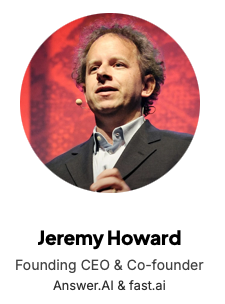
Jeremy Howard — Answer.AI & fast.ai
Jeremy Howard needs little introduction in the Australian AI community — or globally, for that matter. As founding CEO of Answer.AI and co-founder of fast.ai, Jeremy has spent years making deep learning more accessible and more practical. He created ULMFiT, the transfer learning approach at the heart of today’s major language models. A former president and top-ranked competitor at Kaggle, founder of Enlitic (the first company to apply deep learning to medicine), and an Honorary Professor at the University of Queensland, Jeremy brings a rare combination of research depth and real-world impact. His talk details are coming soon — but trust us, you’ll want to be there, he’s promising something new just for AI Engineer.
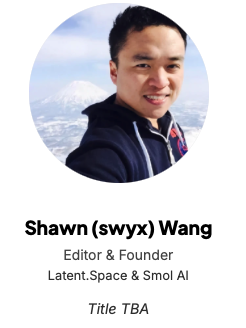
Shawn Wang (swyx) — Latent.Space & Smol AI
If you follow the AI engineering space, you know swyx. He literally coined the term AI engineer in its contemporary context with the seminal Rise of the AI engineer article published in July 2023. Shawn is editor of Latent.Space — the podcast, newsletter, and community that has become essential reading for anyone building with AI — and founder of Smol AI.
He founded and co-organises the AI Engineer conference series. Before that, he led developer tooling at AWS, Two Sigma, and three devtool unicorns (Netlify, Temporal, Airbyte). Having Shawn at AI Engineer Melbourne feels fitting — we’re bringing the conversation he helped start to Australia. Talk details coming soon.
Geoff Huntley — Everything Is a Factory
Software development as we knew it is dead — at least, that’s what Geoff Huntley reckons. As the creator of the Ralph Wiggum Loop, a brute-force AI agent technique that turns simple prompts into fully functional software through automated iteration, Geoff has been at the frontier of AI-driven development. His recent work includes Loom, an AI orchestrator that takes the concept further into full software factory territory, and the “Cursed” programming language — a compiler written entirely by AI loops. In this keynote, Geoff traces the journey from prompt-and-iterate to full orchestration, and asks what it means when code becomes a commodity and engineering becomes orchestration. He currently lives on a goat farm in Australia, which tells you everything you need to know about his energy.
It’s fitting because the first time Jeff spoke about AI and software engineering was at several of our conferences in 2025.
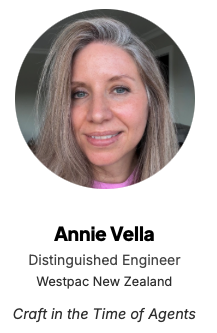
Annie Vella — Craft in the Time of Agents
Annie Vella is a Distinguished Engineer at Westpac New Zealand, and she’s asking the question a lot of us are feeling but not saying out loud: what happens to the craft of engineering when AI does more of the building? You feel more productive than ever.
You put on the Iron Man suit and you’re shipping in hours what used to take weeks. And you’re exhausted by Wednesday. Drawing from her recently completed Master’s research on AI’s impact on software engineering, Annie explores why this transition hits so differently depending on where you are in your career — and why who thrives most comes down to mindset, not circumstance.
Her March 2025 piece, The Software Engineering Identity Crisis, saw huge interest around the world.
This is a talk for anyone who’s noticed they’re getting more done while enjoying it less, and wants to understand why that’s a system design problem, not a personal one.
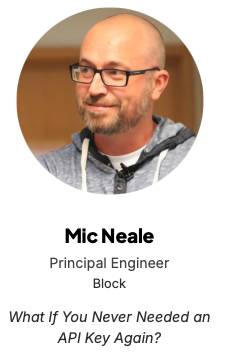
Mic Neale — What If You Never Needed an API Key Again?
Mic Neale is a Principal Engineer at Block, where he works on Goose, the company’s open-source agentic coding system. But his talk goes well beyond coding agents. Mic is building a working prototype of a decentralised mesh LLM — a system where individuals and small teams pool their spare compute to collectively run open models that none of them could run alone. When your GPU is idle, it contributes to the mesh. When you need capacity, the mesh is there. No cloud bill, no API dependency.
He’ll walk through how the mesh works technically — coordination, model sharding, latency management — and where it’s headed: a future where the economics of running frontier-class open models shift from “data centre required” to “your neighbourhood has enough.”
With a background that includes co-founding CloudBees, building the Drools inference engine at Red Hat, and two decades at the intersection of developer tooling and distributed systems, Mic brings serious infrastructure credibility to a genuinely ambitious project.
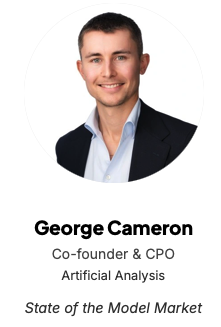
George Cameron — State of the Model Market
If you’ve ever tried to choose between AI models and felt lost in a sea of benchmarks, pricing tiers, and speed claims, George Cameron built the thing you needed. As co-founder and CPO of Artificial Analysis, the independent benchmarking platform backed by AI Grant from Nat Friedman and Daniel Gross, George and his team provide the data that engineering teams actually rely on to make model selection decisions.
Previously a senior strategy consultant at Altman Solon specialising in technology and data centre strategy, George spotted a critical gap: developers faced a 1,000x price difference between models with no reliable way to compare them. His keynote will give us the state of play across the model market — what’s changed, what’s coming, and what it means for how we build.
George is an Australian seeing genuine success in the industry in San Francisco and globally. And we’re excited for him to make the trek back home to share his insights with us.
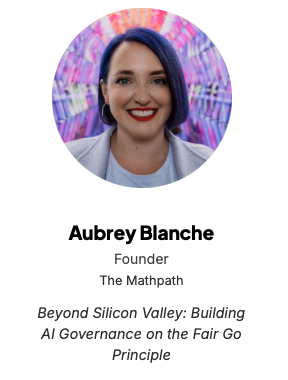
Aubrey Blanche — Beyond Silicon Valley: Building AI Governance on the Fair Go Principle
Aubrey Blanche is an expert in equitable culture, ethical operations, and responsible AI. A recovering American now based in Australia, Aubrey argues that current AI governance frameworks, largely imported from Silicon Valley, embed distinctly American values that don’t always align with Australian regulatory expectations and social norms.
Her keynote introduces a distinctly Australian responsibility framework for AI implementation, one built on principles of mateship, pragmatic skepticism, and community-oriented thinking.
Rather than treating AI risks as individual consumer choices or market failures, Aubrey positions AI governance as a collective responsibility — where technology serves the common good and earns trust through demonstrated fairness. She sits on the boards of the Culture Amp Foundation and Circle of Blue, and her work has been featured in Wired, the Wall Street Journal, and the Australian Financial Review.
We hope you agree this is already shaping up as an incredible program, and we have dozens more speakers to add in the coming weeks. Tickets are selling really quickly, so we recommend you don’t wait around too long, or you might just miss out.
AI Engineer Melbourne takes place June 3–4, 2026 in Melbourne.
Great reading, every weekend.
We round up the best writing about the web and send it your way each Friday.